My Role:
UX/UI Designer | Prototyper | Product Testing and Quality Assurance.
Product Description:
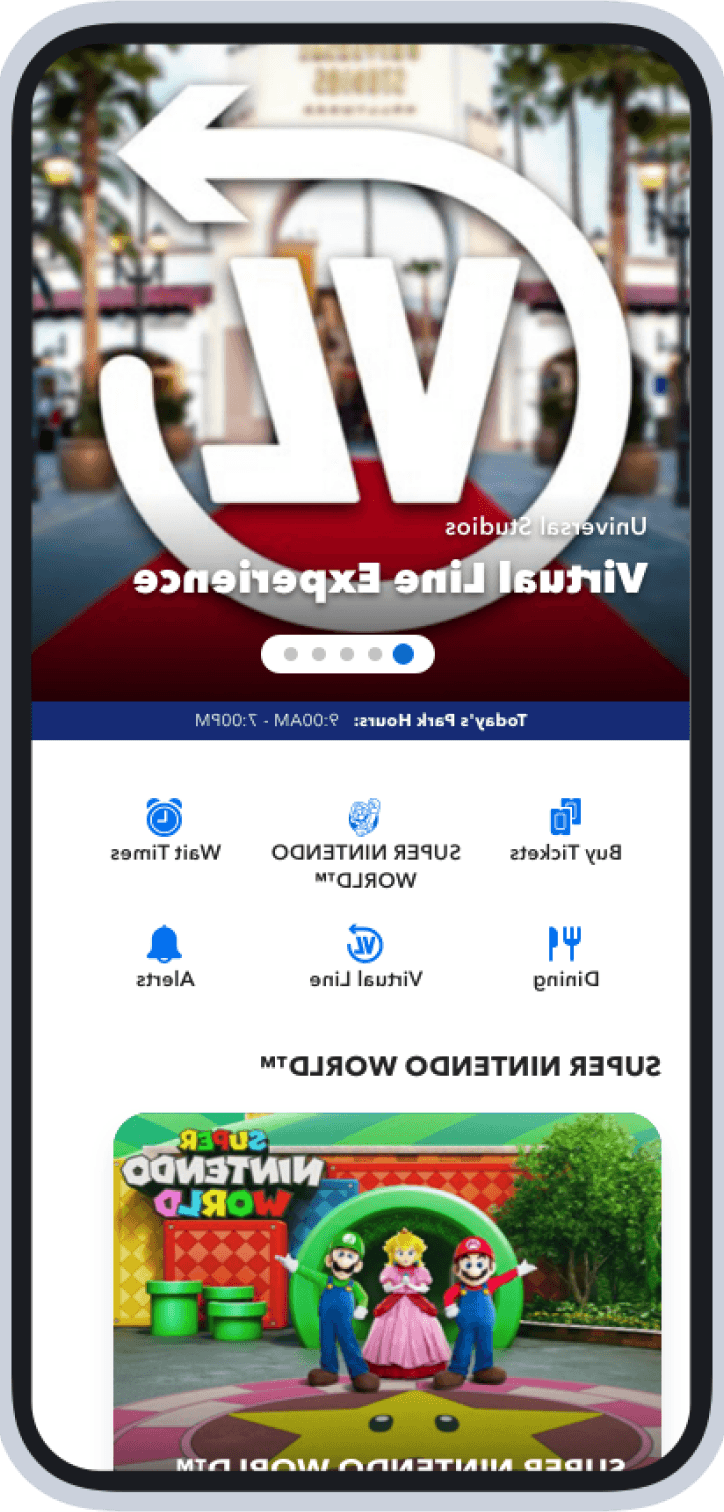
Universal Parks and Resorts aimed to enhance the guest park experience by allowing mobile app users to access virtual queues and redeem Express Passes for selected attractions, known as The Virtual Line Experience™.
Terms:
• UEP - Universal Express Pass.
• SAP - Single Attraction Express Pass.
• VL - short for Virtual Line.
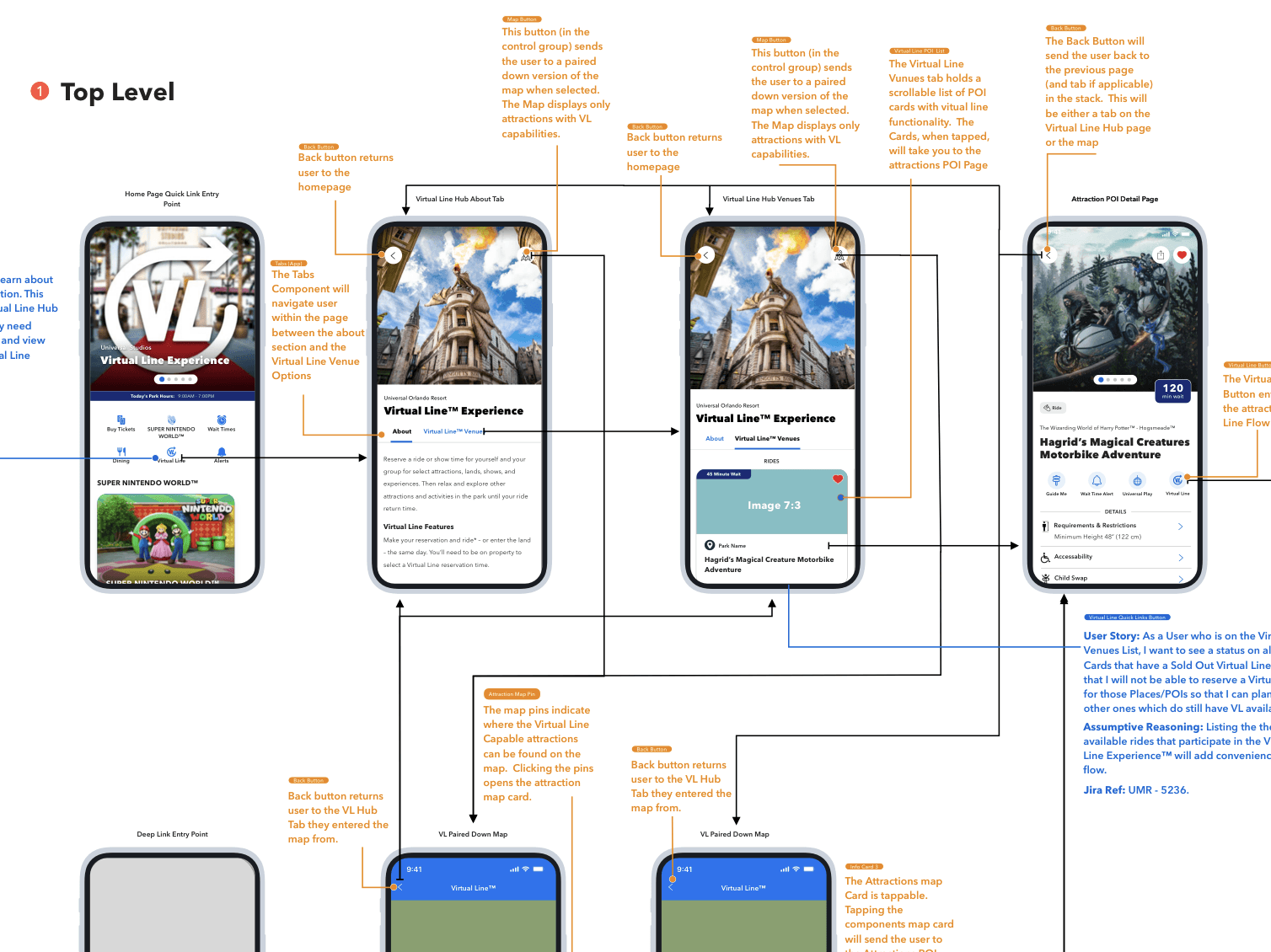
The Virtual Line Experience is a new hybrid feature (in-park using the mobile app) allowing guests to virtually queue themselves in line for busy rides on any given day.
This was a new feature that was inspired by competition in the market, this making it crucial to visualize the virtual queue in a manner that seamlessly integrated with the existing park experience and new mobile app experience.
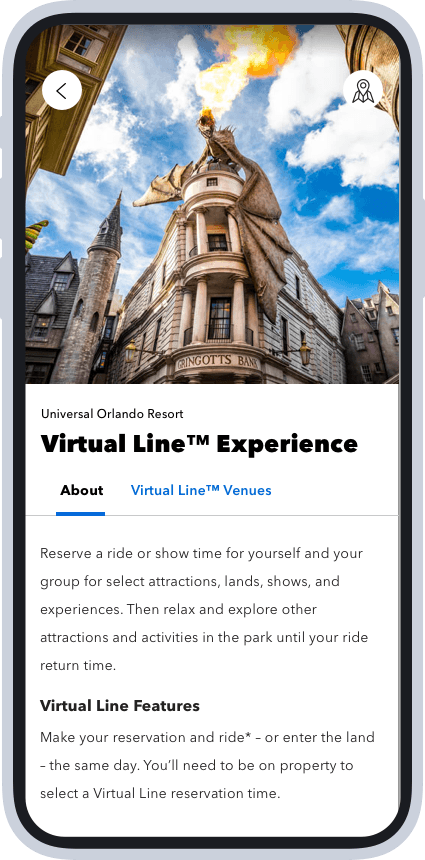
New into the Old:
"The Universal Mobile App had an outdated ticket redemption system and wanted to add a new 'Wallet' feature. In our design sprint, we asked: 'How can we smoothly integrate a new virtual line queue using the existing design patterns?'"
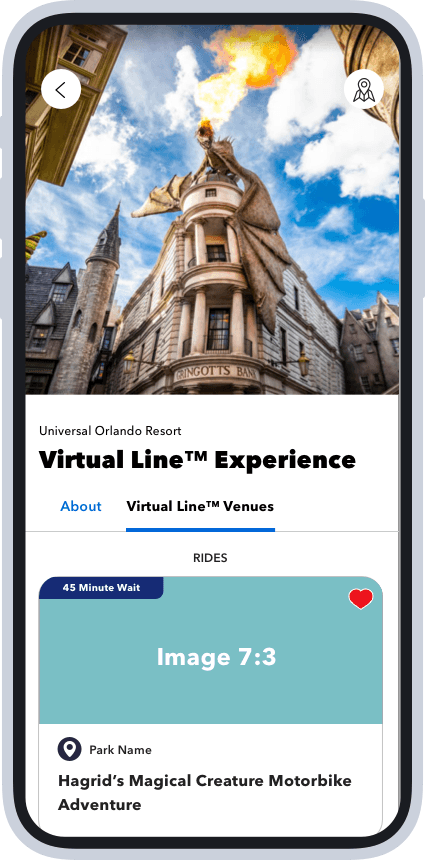
The following presents the outcomes of the “Virtual Line Experience” re-write I designed alongside Chaos Theory’s Tim Eulie, for Universal Parks and Resorts.
The Mobile - Rewrite project was a team of 8 designers, 4 product managers, and an external development team. Below, you'll discover the results of my designs alongside our collaboration in developing the feature known as 'The Virtual line Experience'.
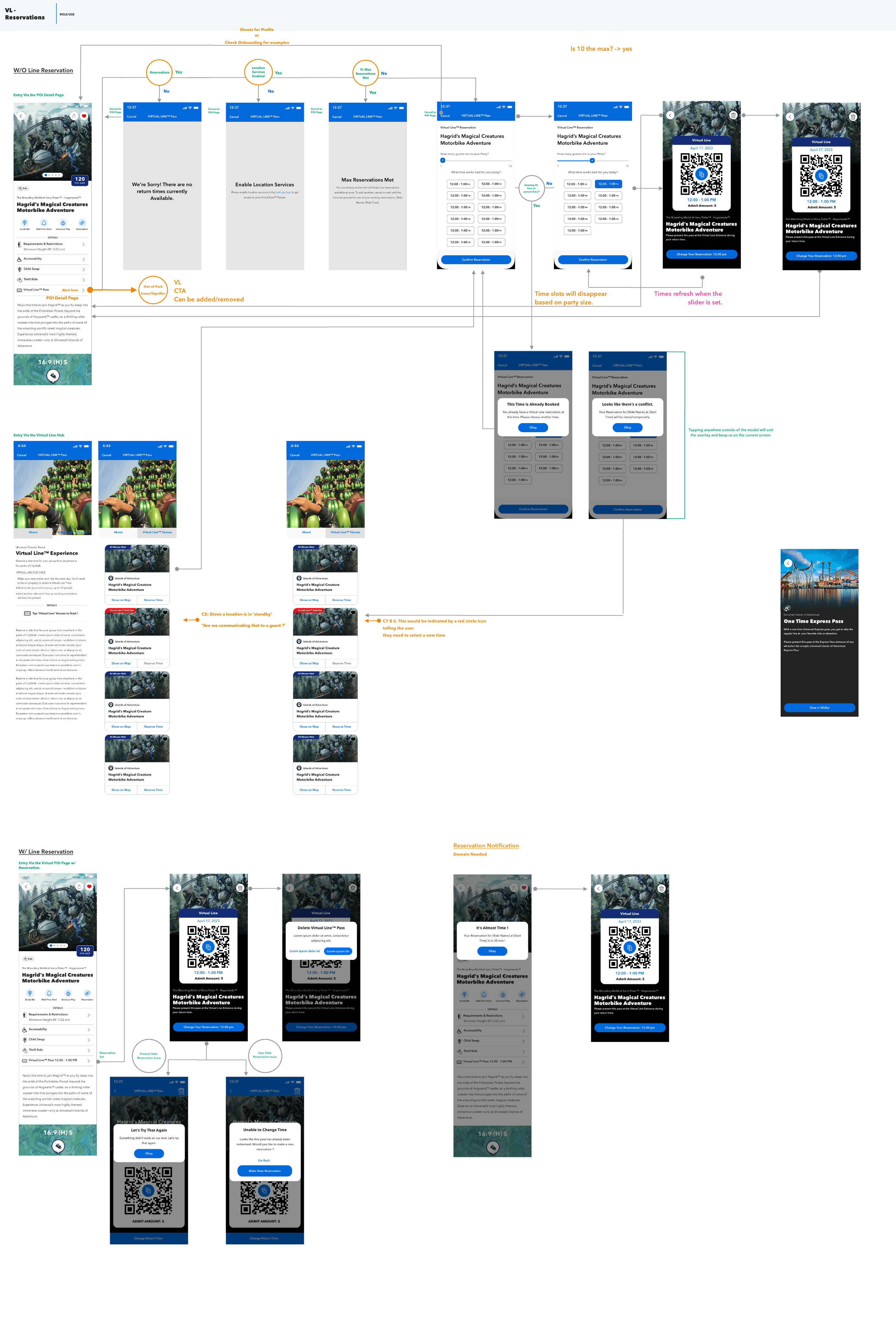
I started the project by collaborating with the product team. Recognizing Universal's non-tech focus, I aimed to align user-centered design with their revenue goals. I began by creating user flows and wireframes based on available secondary data.
During the initial brainstorming phase, I faced the challenge of modernizing the product and aligning it with user needs. I presented new ideas to clarify Universal's in-park jargon, such as UEP, SEP, Virtual Line, and Virtual Queues.
Initially, steering this product to better align with user needs was met with resistance. I defended their framework in meetings and emphasized the importance of a human-centered design evaluation for better and cost-effective results.
Coming from a user-centered and human-computer-interaction background, I served as a primary advocate for users and solutions that might have been overlooked in the production pipeline.
To the Top
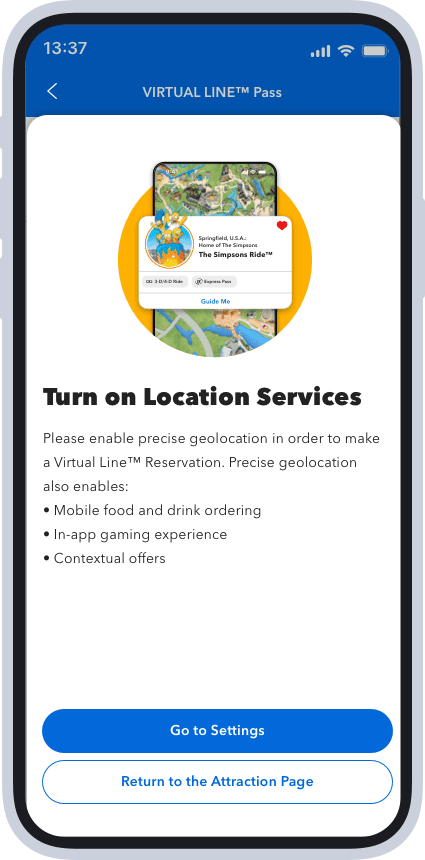
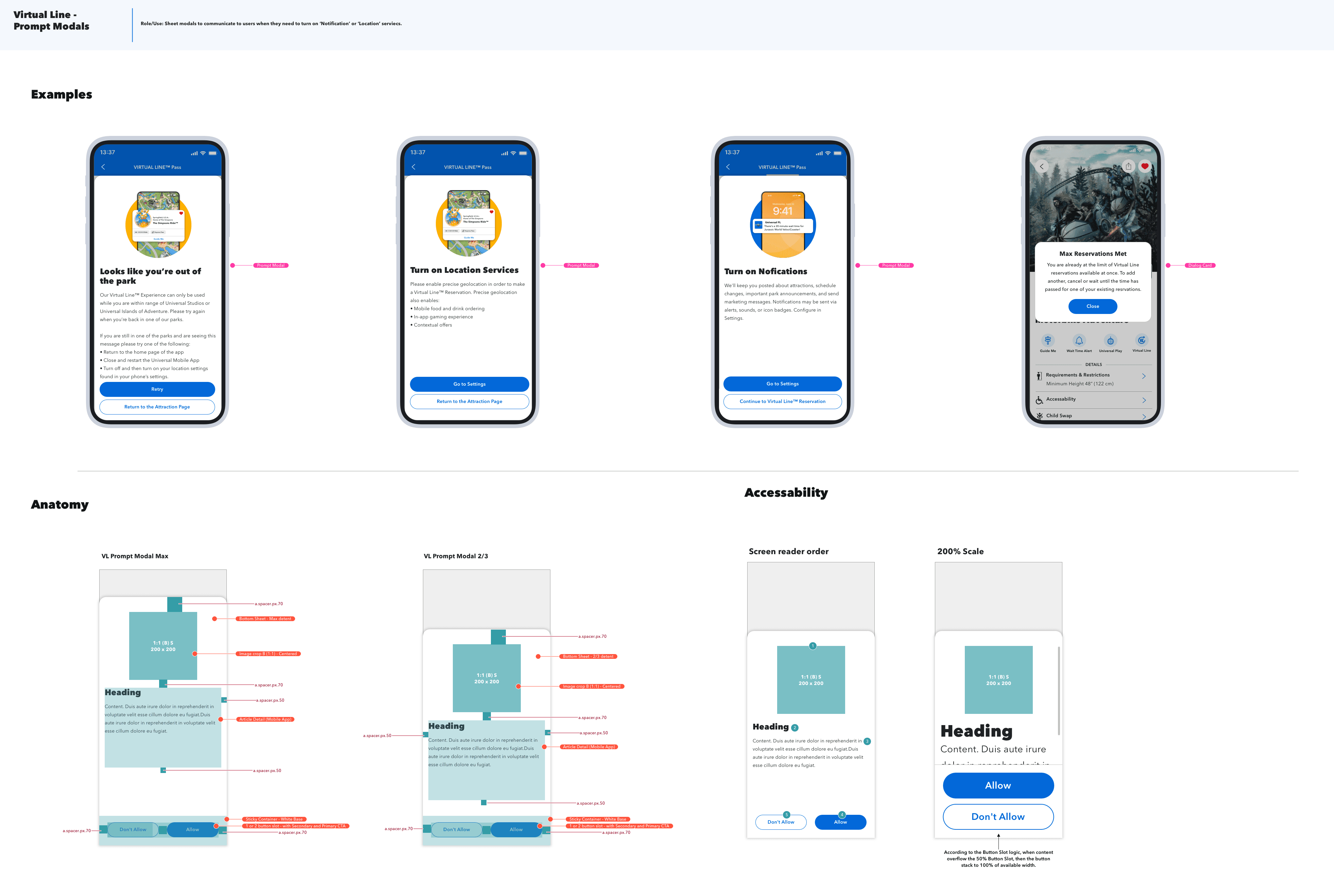
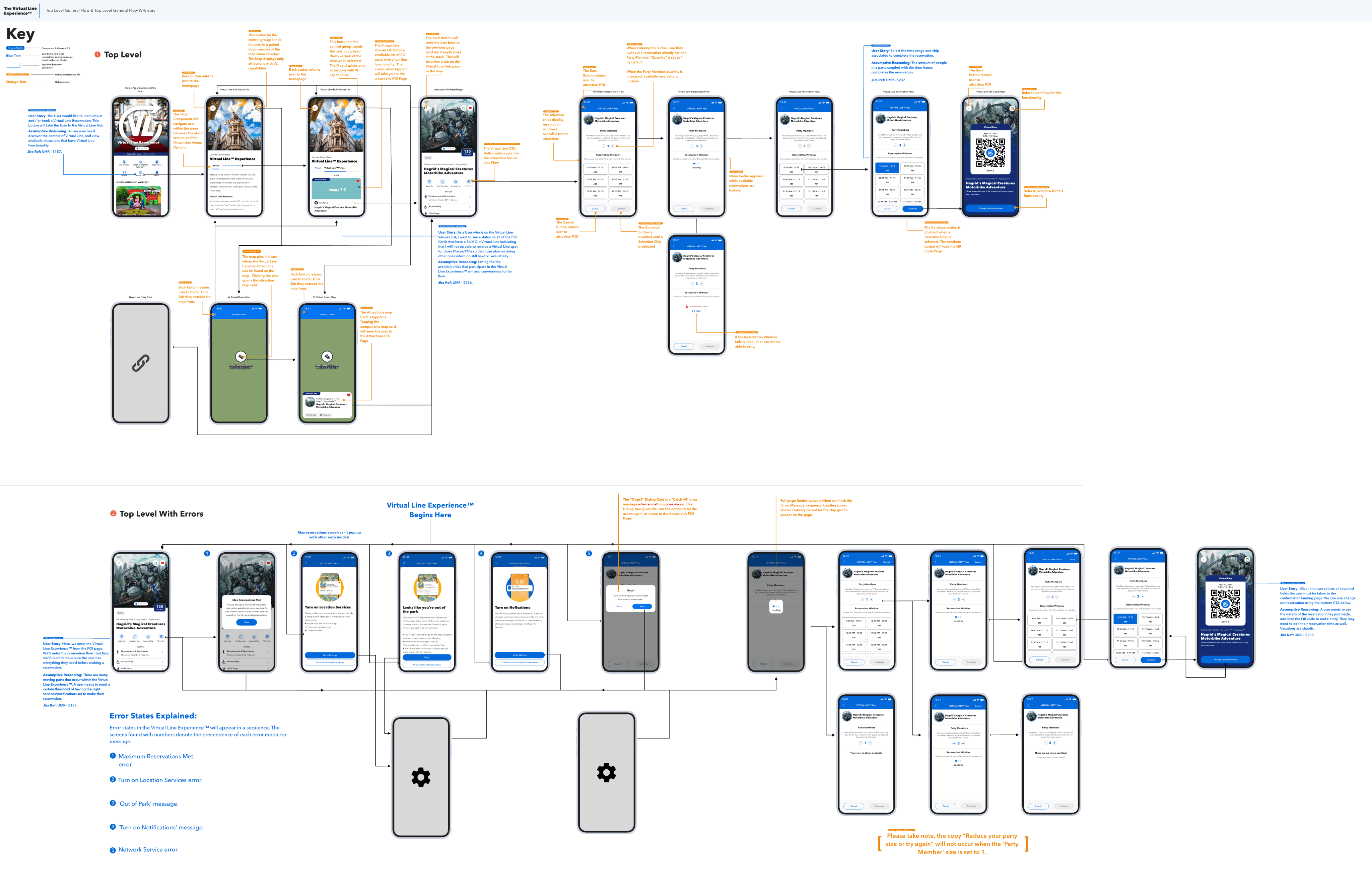
User Story: When users don't have location or notification settings on, a prompt will appear with two options to proceed. Users need location services for accurate reservation data and notifications to receive updates.
Assumptive Reasoning: To make a VL reservation, users must enable location services for accurate data retrieval. They will also need to enable notifications to receive updates on their reservation.
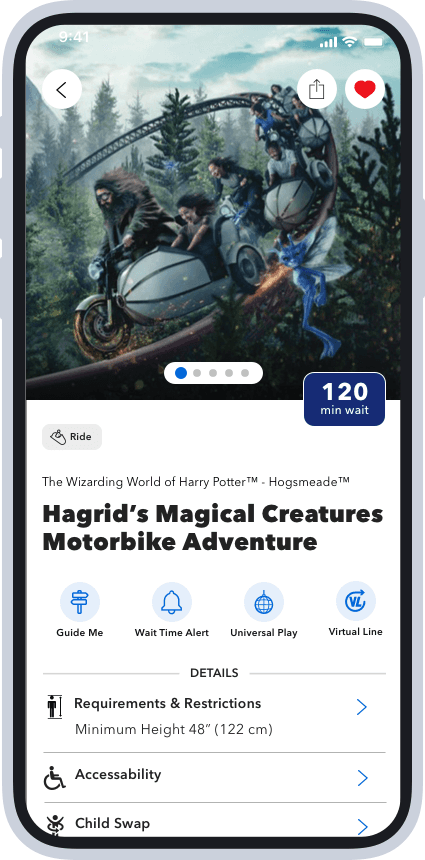
Please remember the following:
"User Stories" represent the outcomes of PRD and user flows based on secondary research and ideation.
"Assumptive Reasoning" denotes the selection criteria for solutions, influenced by secondary research and cross-collaboration meetings.
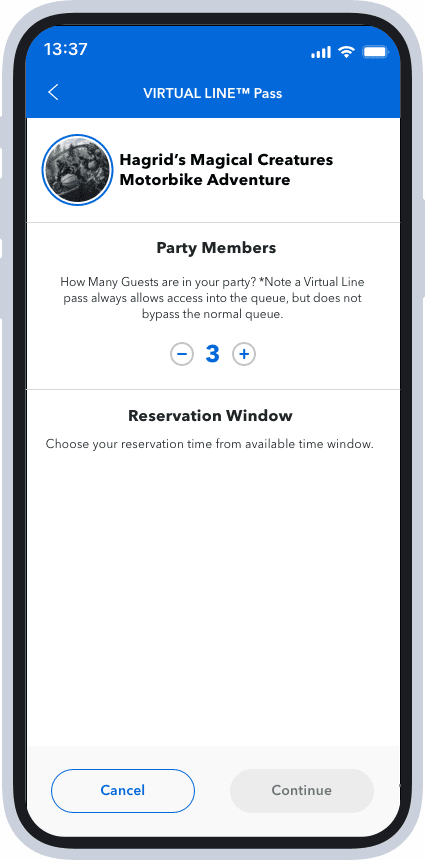
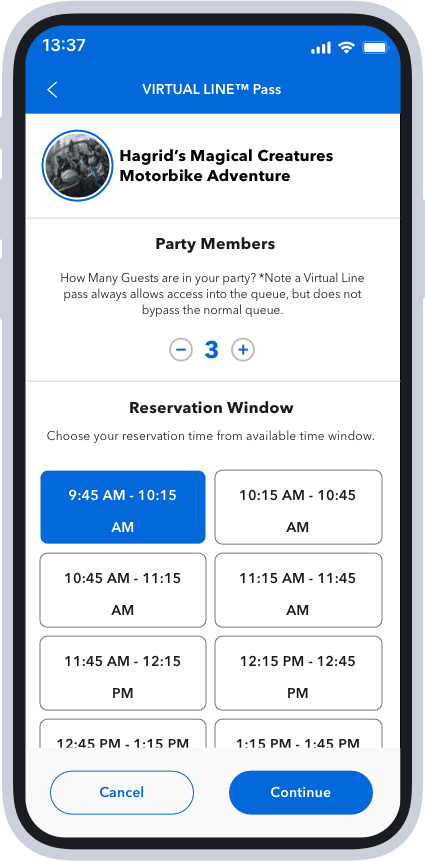
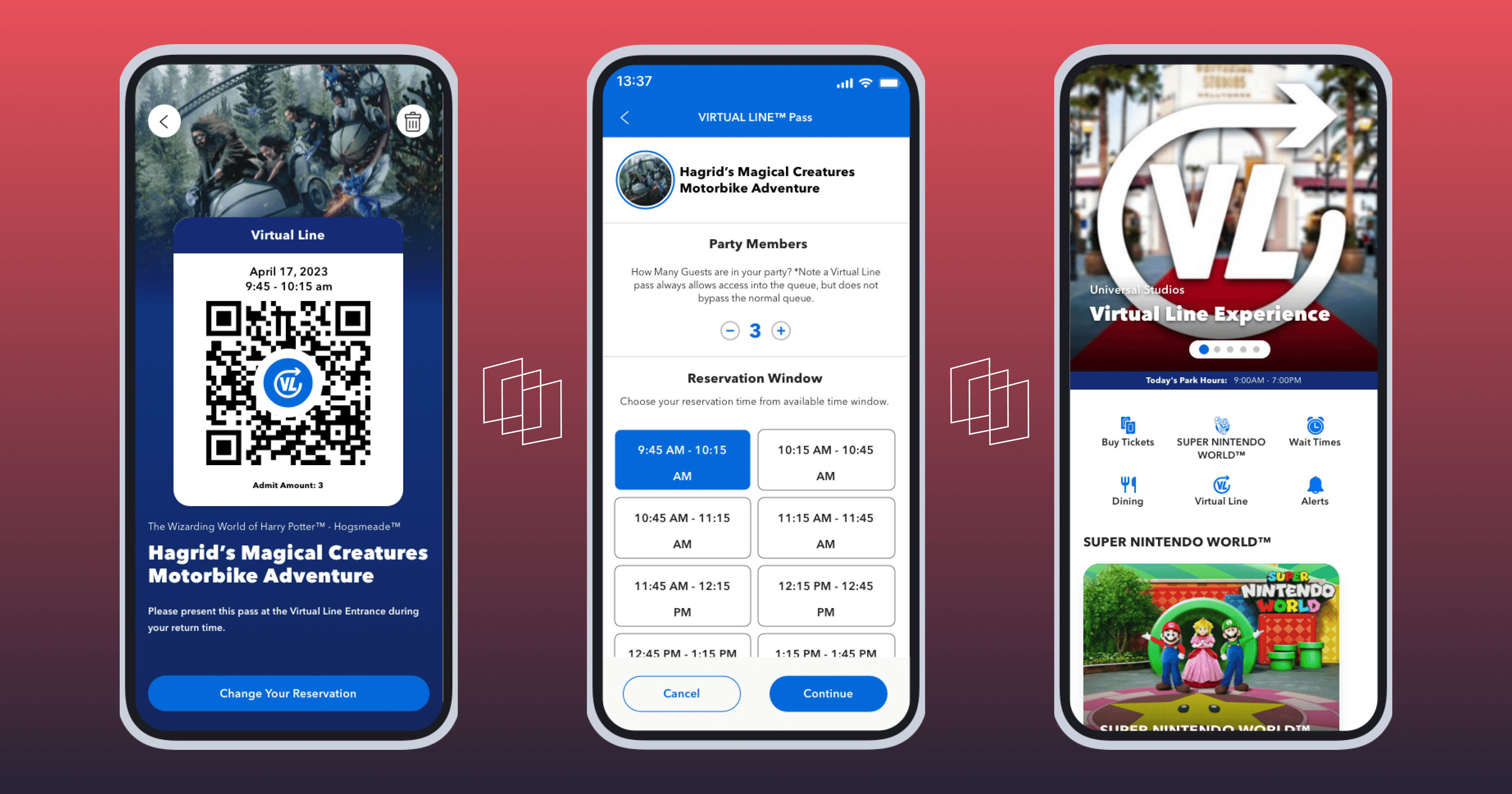
User Story: Once all permissions are enabled, users in the park can select the number of 'Party Members' for available reservation times. If no times are available, the 'Reservation Window' won't display.
Assumptive Reasoning: To effectively show how the system works in the real world, using an asynchronous display allows us to see what is and isn’t allowed. The design choice aims to prevent errors by ensuring that the 'Party Member' number aligns with the 'Reservation Window' data.
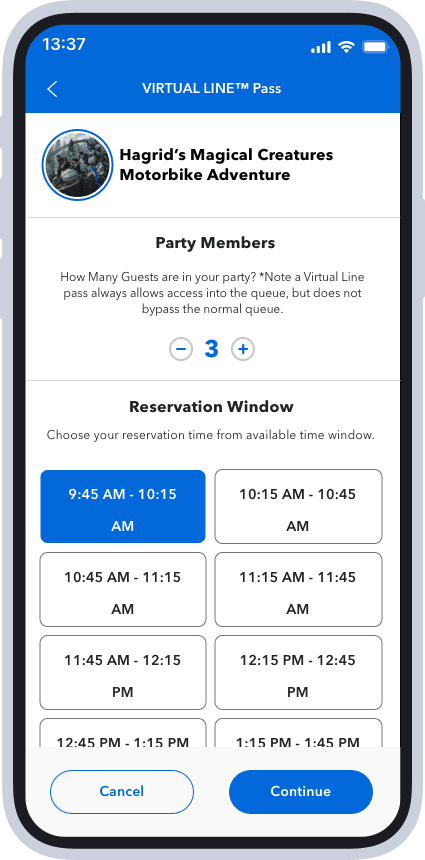
User Story: Once the party size has available reservations, a selection chip grid for 'Reservation Windows' becomes available.
Assumptive Reasoning: The reservation process is divided into two steps to help users understand the Virtual Line Experience. Descriptors below each section's header explain the function and purpose of each step.
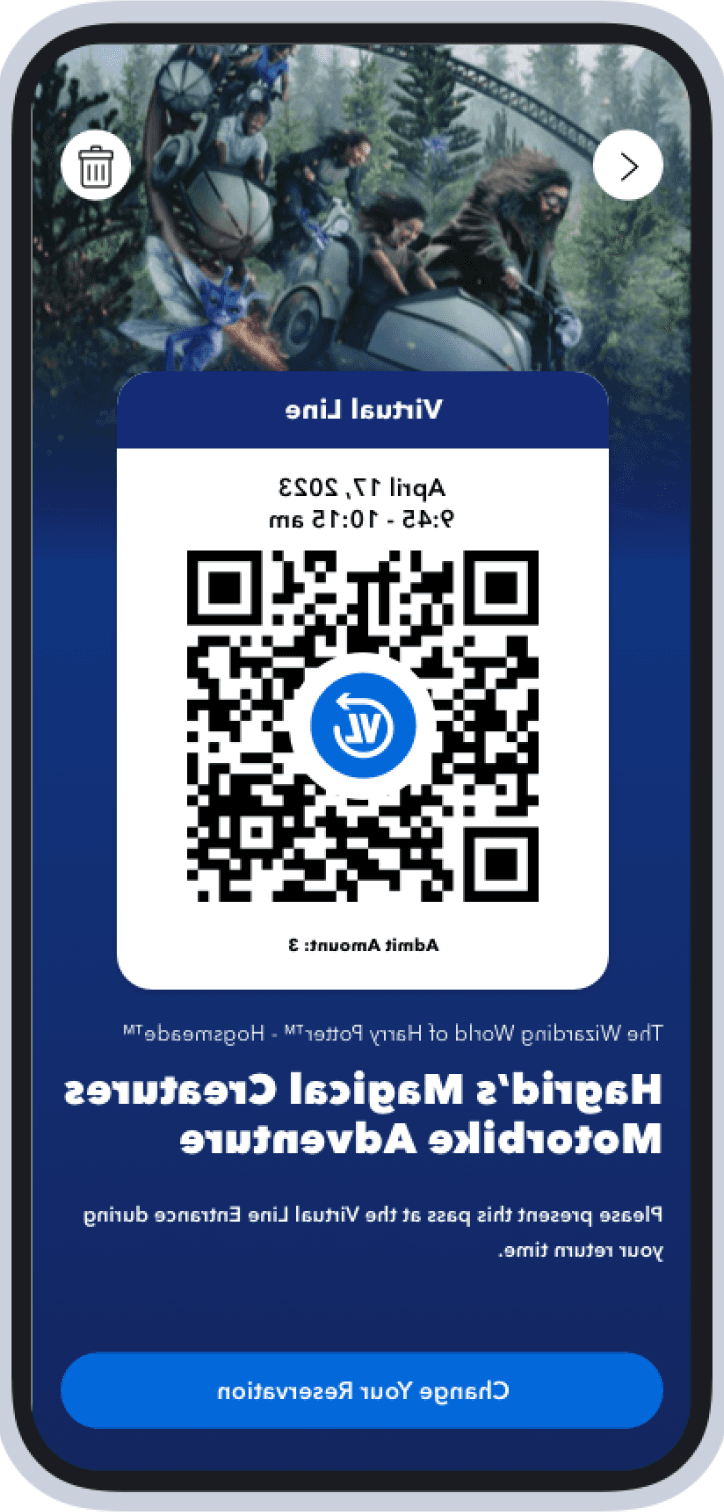
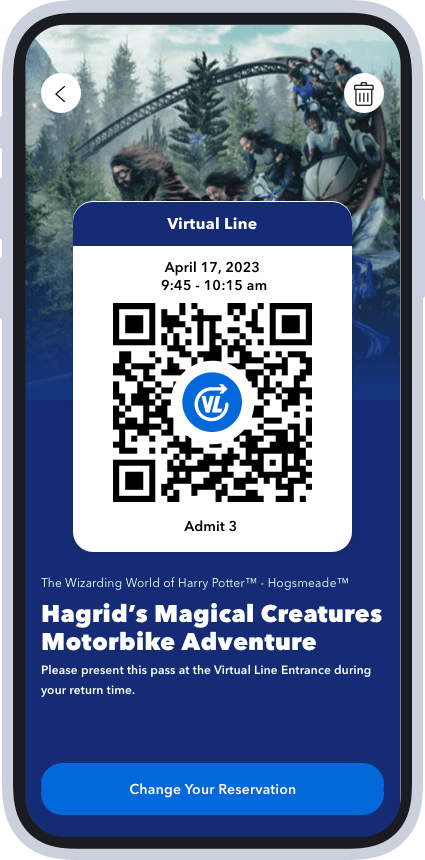
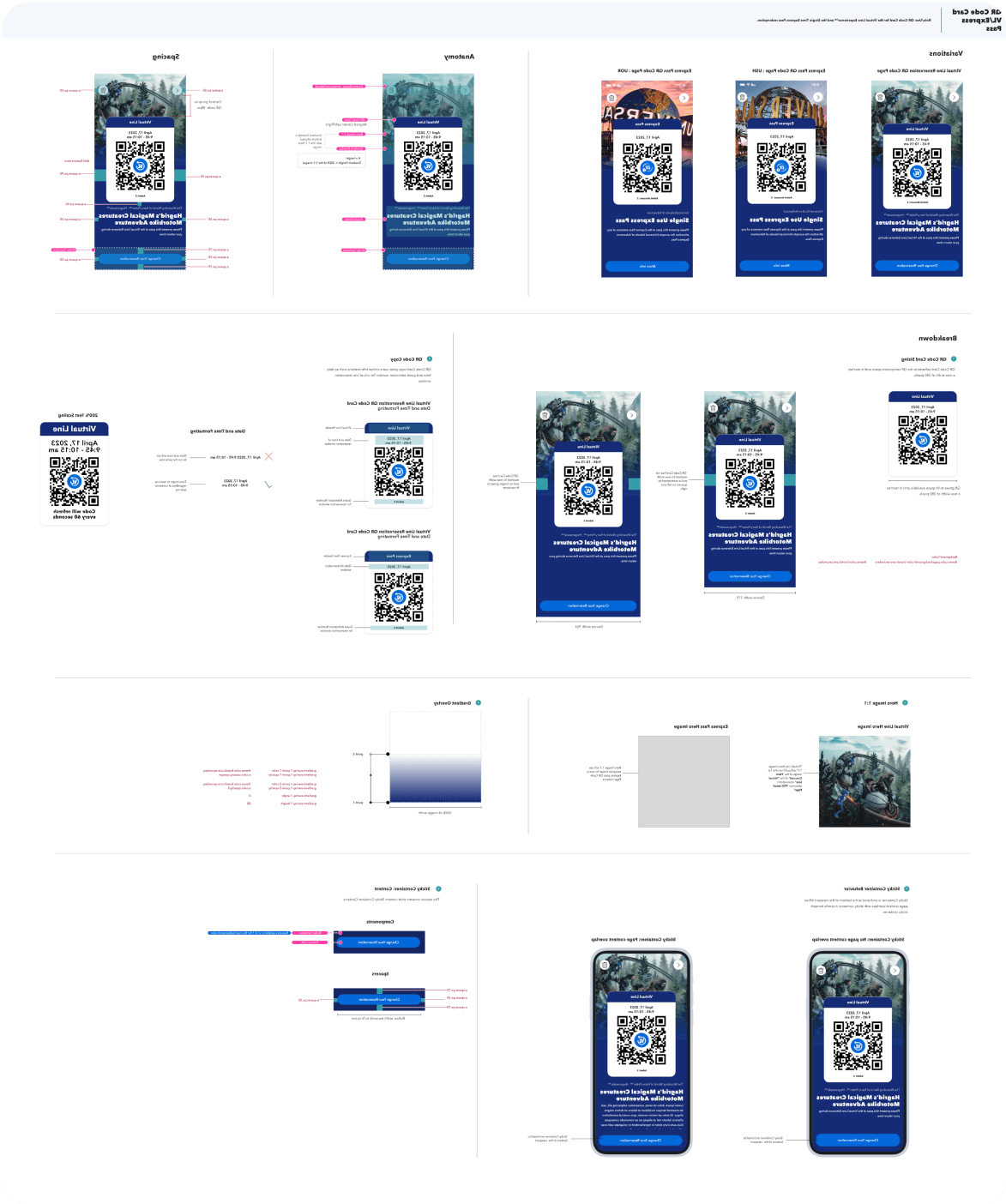
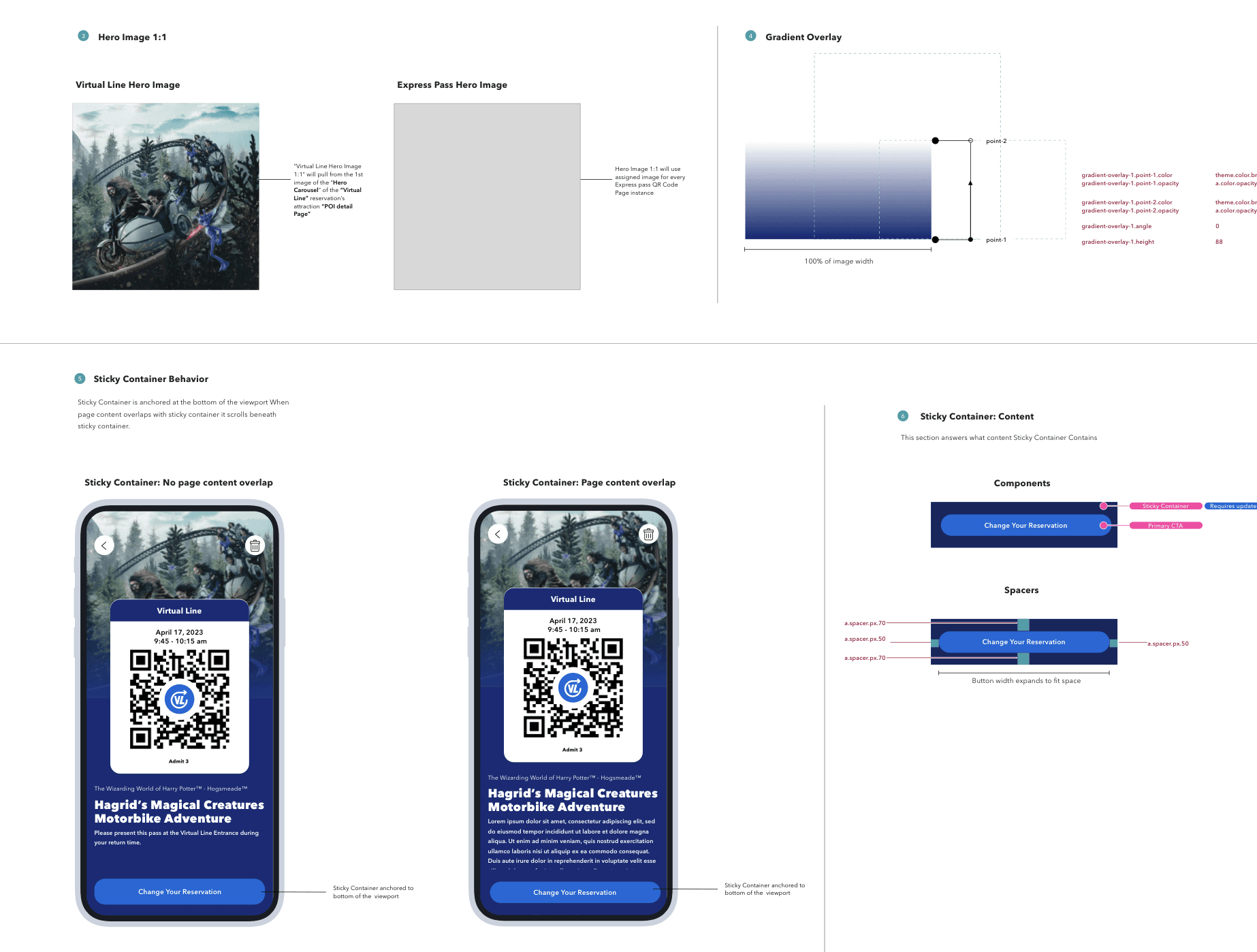
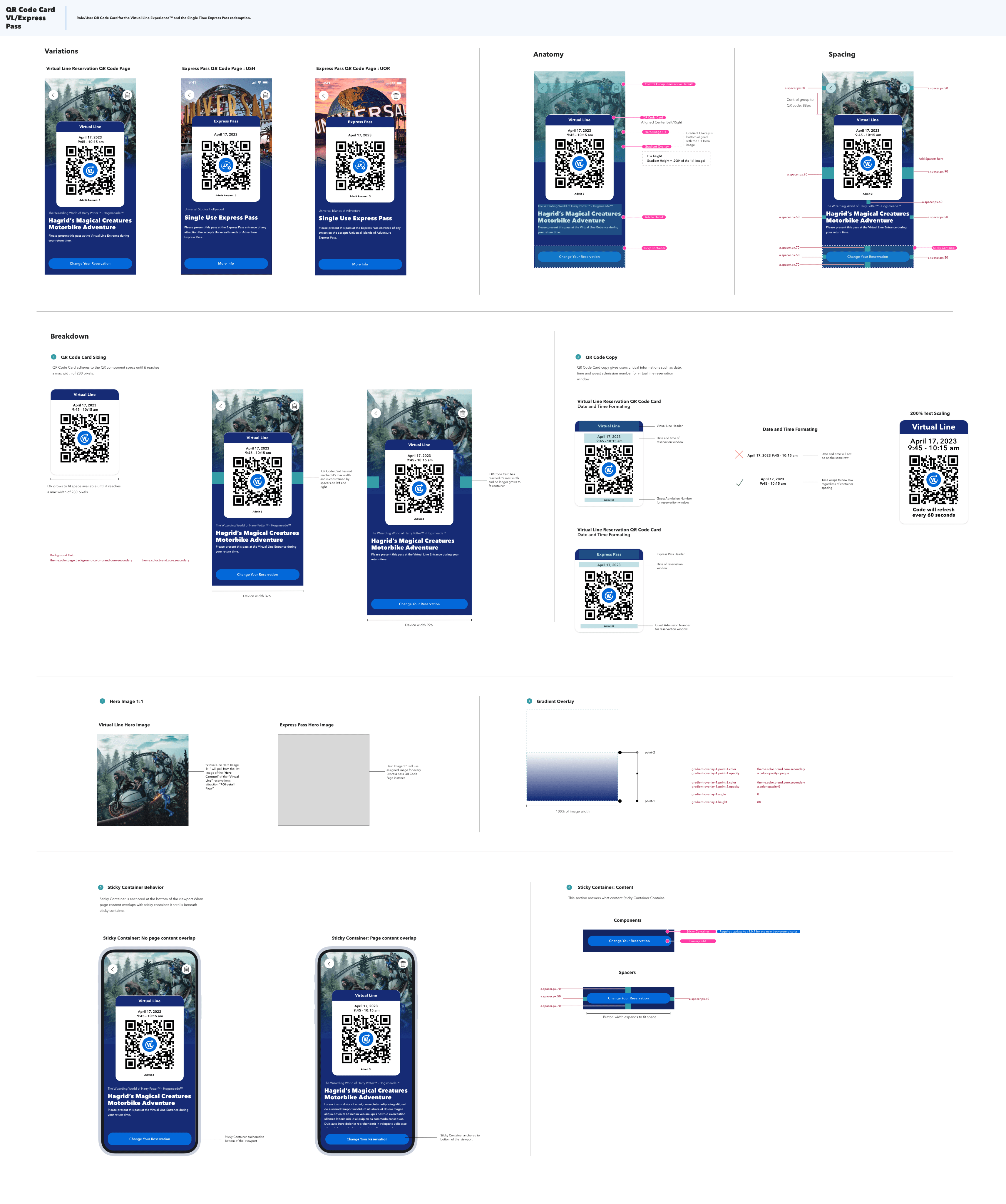
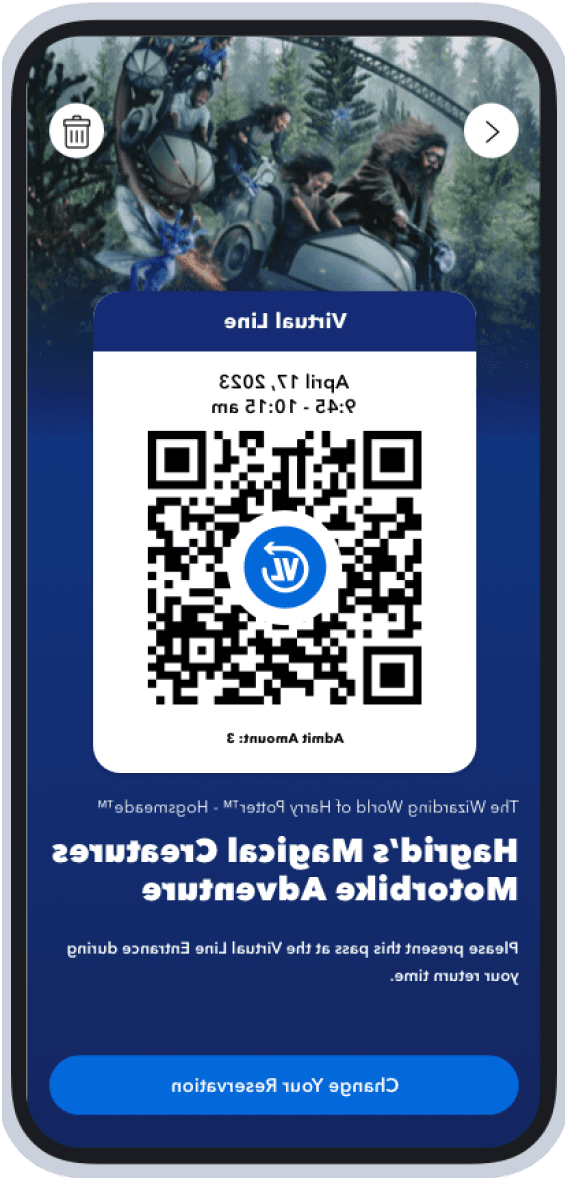
User Story: Ticket scanning at Universal Studios now uses digital platforms for consistency and efficiency. Users can access a VL QR code similar to traditional park entry tickets.
Assumptive Reasoning: Scanning tickets at Universal has pretty much been moved to digital spaces. To provide consistency and push efficiency, the users should be able to access a VL QR code that is similar to the tickets they used to get into the park with.
The Virtual Line Experience development started in the final quarter of 2023, followed by extensive feature testing and inquiries into user motivations and product solutions.
I contributed to the quality assurance process at Universal, providing insights to our engineers and gaining a better understanding of our capabilities.
I'm grateful for the support from the Universal team, my mother, and God.
Universal’s Mobile Re-Write
The Virtual Line Experience
My Role:
UX/UI Designer | Prototyper | Product Testing and Quality Assurance.
Product Description:
Universal Parks and Resorts aimed to enhance the guest park experience by allowing mobile app users to access virtual queues and redeem Express Passes for selected attractions, known as The Virtual Line Experience™.
Terms:
• Appointment Time/Return Time - Both refer to the time-slots that a guest can reserve a ride/show for.
• UEP - Universal Express Pass.
• SAP - Single Attraction Express Pass.
• Re-Racked - When a ride/show goes down, the reservations that guests have are "re-racked". Internally, Universal says that the guest was "re-racked". This entitles them to either a new reservation, or a UEP.
• VL - short for Virtual Line.
The Virtual Line Experience
The Virtual Line Experience is a new hybrid feature (in-park using the mobile app) allowing guests to virtually queue themselves in line for popular, new, or generally busy rides open on any given day.
This was a new feature that was inspired by competition in the market, thus making it crucial to visualize the virtual queue in a manner that seamlessly integrated with the existing park experience and new mobile app experience.
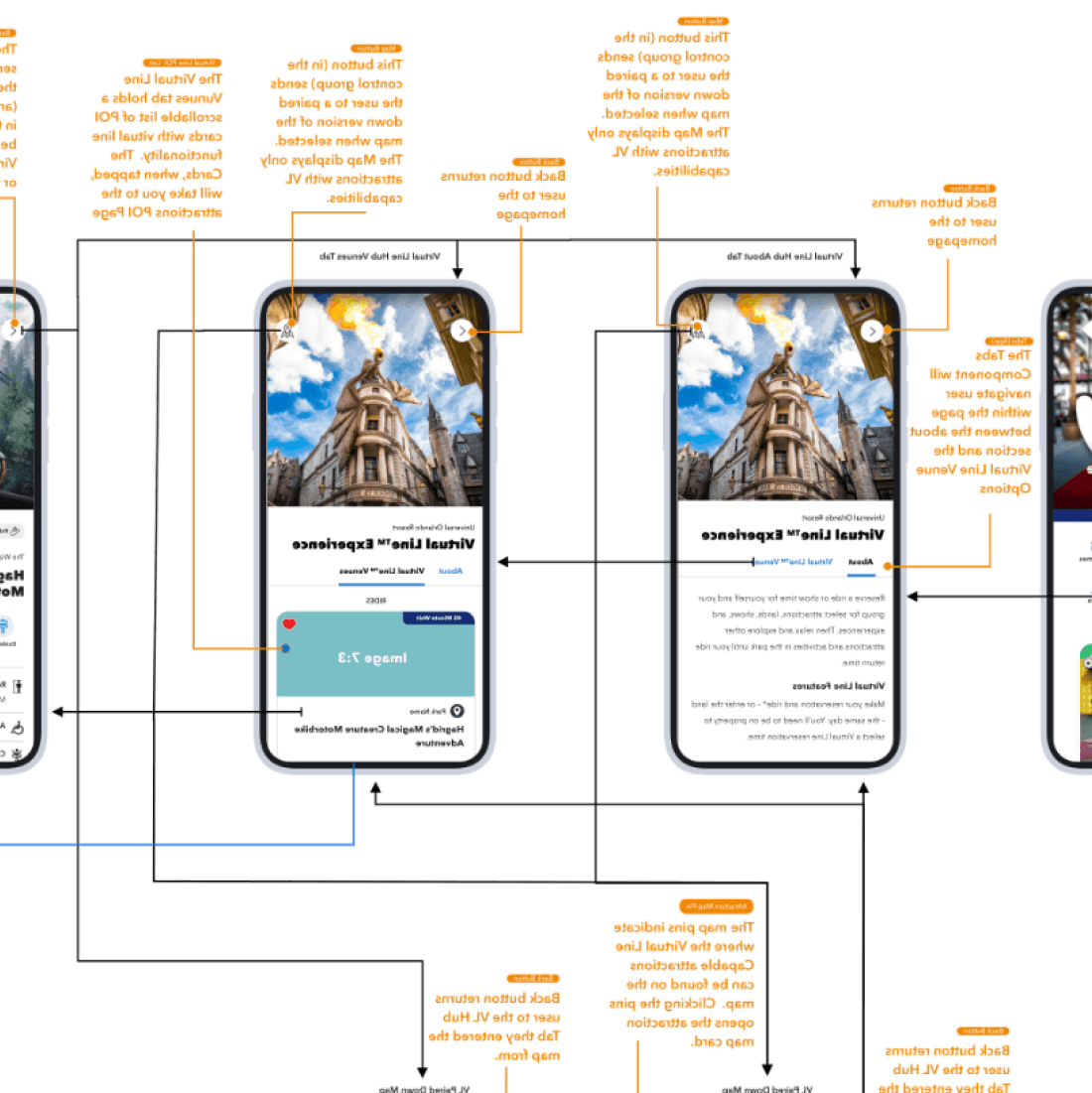
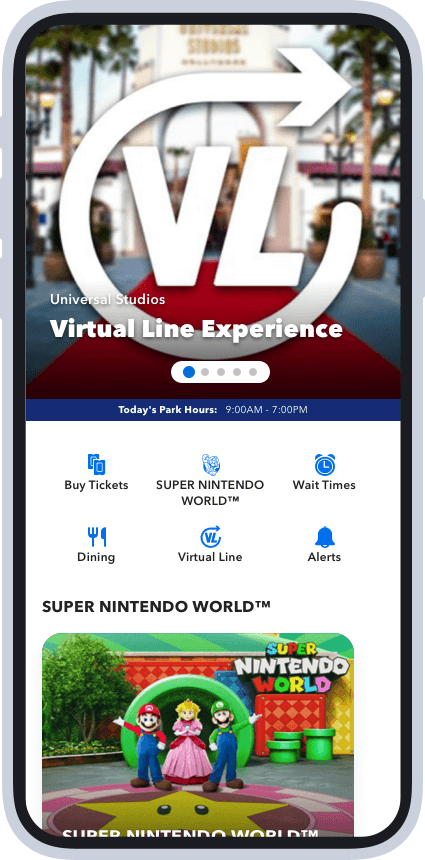
Product Screen Name: “VL Hub - 'About' tab.”
New into the Old:
The Universal Mobile App had an outdated ticket redemption system and wanted to add a new 'Wallet' feature. Designers had to figure out how to incorporate QR codes for quick scanning at kiosks. In a design sprint, the challenge was to visualize a new virtual line queue using existing design patterns in the app.
Product Screen Name: “VL Hub - 'Venues' tab.”
How Might We Integrate The Old
Into The New?
The following project is the outcome of the "Virtual Line Experience" I designed alongside Chaos Theory's Tim Eulie, for Universal Parks and Resorts.
The entire Mobile - Rewrite project was a team of 8 designers, 4 product managers, and an external development team. Below, you'll discover the results of my designs alongside our collaboration in developing the feature known as 'The Virtual Line Experience'.
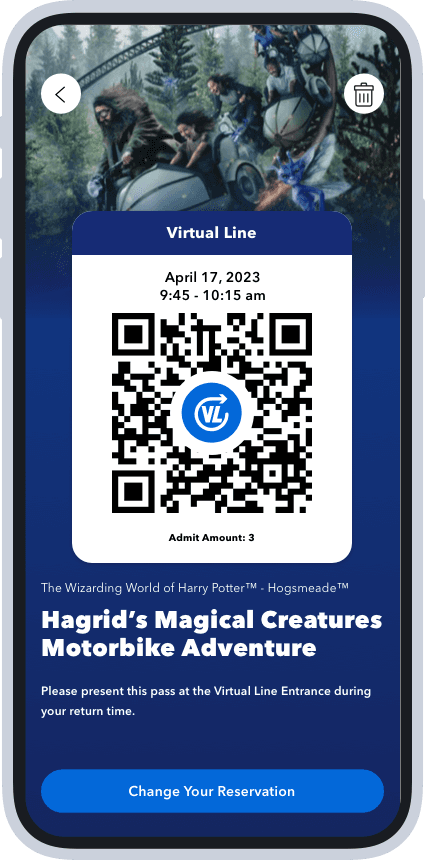
Product Screen Name: “VL QR Code.”
Knowledge in the Head.
I started the project by collaborating with the product team. Recognizing Universal's non-tech focus, I aimed to align user-centered design with their revenue goals. I began by creating user flows and wireframes based on available secondary data.
This posed a challenge during the initial ideation phase, as I aimed to better comprehend not only how to modernize the product, but also how to align it with user needs.
Early on, I approached them with novel ideations to address the ambiguity of Universal's in-park jargon: UEP, SEP, Virtual Line, Virtual Queues etc.
Knowledge in The World.
Facing this challenge, I initially didn't receive positive feedback when I tried to steer the product in a direction that better suited user needs.
The team had concerns about the scope of the product at every stage and wanted to remove basic permission screens to cut development costs.
I emphasized in meetings how a user-centered design evaluation would lead to better results, being cost-effective and essential.
Advocating for more impactful user outcomes was both enjoyable and challenging given the diverse talents at Universal's theme park team.
Coming from a user-centered design background, I championed user needs and design paradigms, contributing to UI improvements, storyboard illustrations, design system updates, and post-launch documentation.
To the Top
The Saga of: The VL Experience
Please remember the following:
"User Stories" represent the outcomes of PRD and user flows based on secondary research and ideation.
"Assumptive Reasoning" denotes the selection criteria for solutions, influenced by secondary research and cross-collaboration meetings.
User Story: When users don't have location or notification settings on, a prompt will appear with two options to proceed. Users need location services for accurate reservation data and notifications to receive updates.
Assumptive Reasoning: To make a VL reservation, users must enable location services for accurate data retrieval. They will also need to enable notifications to receive updates on their reservation.
User Story: Once all permissions are enabled, users in the park can select the number of 'Party Members' for available reservation times. If no times are available, the 'Reservation Window' won't display.
Assumptive Reasoning: To effectively show how the system works in the real world, using an asynchronous display allows us to see what is and isn’t allowed. The design choice aims to prevent errors by ensuring that the 'Party Member' number aligns with the 'Reservation Window' data.
User Story: Once the party size has available reservations, a selection chip grid for 'Reservation Windows' becomes available.
Assumptive Reasoning: The reservation process is divided into two steps to help users understand the Virtual Line Experience. Descriptors below each section's header explain the function and purpose of each step.
User Story: After completing the reservation information, you will receive a QR code to enter the Virtual Line queue for your selected attraction. The QR code's top header will provide usage instructions and specify the linked number of party members.
Assumptive Reasoning: Ticket scanning at Universal Studios now uses digital platforms for consistency and efficiency. Users can access a VL QR code similar to traditional park entry tickets.
V for Victory, L for Longevity.
The Virtual Line Experience development started in the final quarter of 2023, followed by extensive feature testing and inquiries into user motivations and product solutions.
I contributed to the quality assurance process at Universal, providing insights to our engineers and gaining a better understanding of our capabilities.
I'm grateful for the support from the Universal team, my mother, and God.
Universal’s Mobile Re-Write
The Virtual Line Experience
My Role:
UX/UI Designer | Prototyper | Product Testing and Quality Assurance.
Product Description:
Universal Parks and Resorts aimed to enhance the guest park experience by allowing mobile app users to access virtual queues and redeem Express Passes for selected attractions, known as The Virtual Line Experience™.
Terms:
• Appointment Time/Return Time - Both refer to the time-slots that a guest can reserve a ride/show for.
• UEP - Universal Express Pass.
• SAP - Single Attraction Express Pass.
• Re-Racked - When a ride/show goes down, the reservations that guests have are "re-racked". Internally, Universal says that the guest was "re-racked". This entitles them to either a new reservation, or a UEP.
• VL - short for Virtual Line.
The Virtual Line Experience
The Virtual Line Experience is a new hybrid feature (in-park using the mobile app) allowing guests to virtually queue themselves in line for popular, new, or generally busy rides open on any given day.
This was a new feature that was inspired by competition in the market, thus making it crucial to visualize the virtual queue in a manner that seamlessly integrated with the existing park experience and new mobile app experience.
Product Screen Name: “VL Hub - 'About' tab.”
New into the Old:
The Universal Mobile App had an old ticket redemption system and wanted to add a new 'Wallet' feature. Our team aimed to visualize QR codes for quick scans at kiosks and create a new virtual line queue using existing design patterns in the mobile app.
Product Screen Name: “VL Hub - 'Venues' tab.”
How Might We Integrate The Old
Into The New?
The following project is the outcome of the “Virtual Line Experience” I designed alongside Chaos Theory’s Tim Eulie, for Universal Parks and Resorts.
The entire Mobile - Rewrite project was a team of 8 designers, 4 product managers, and an external development team. Below, you'll discover the results of my designs alongside our collaboration in developing the feature known as 'The Virtual Line Experience'.
Product Screen Name: “VL QR Code.”
Knowledge in the Head.
I utilized my existing design system knowledge to kick off the project. I delved into the Product Requirements Document through cross-team meetings, aiming to align user-centered design with Universal's revenue milestones. I created user flows and wireframes based on secondary resource data and Baymard Institution data.
This posed a challenge during the initial ideation phase, as I aimed to better comprehend not only how to modernize the product, but also how to align it with user needs. Early on, I approached them with novel ideations to address the ambiguity of Universal park jargon: UEP, SEP, Virtual Line, Virtual Queues etc.
Knowledge in The World.
Facing this challenge, steering the product to better meet user needs was difficult initially. The product was consistently concerned about scope at every phase, even considering removing essential screens to reduce costs. I spent most of my meetings defending their framework and emphasizing how a human-centered design evaluation would lead to better results at a lower cost.
Advocating for more impactful user outcomes was both enjoyable and challenging given the diverse talents at Universal's theme park team. Coming from a user-centered design background, I championed user needs and design paradigms, contributing to UI improvements, storyboard illustrations, design system updates, and post-launch documentation.
The Saga of: The VL Experience
Please remember the following:
"User Stories" represent the outcomes of PRD and user flows based on secondary research and ideation.
"Assumptive Reasoning" denotes the selection criteria for solutions, influenced by secondary research and cross-collaboration meetings.
User Story: When users don't have location or notification settings on, a prompt will appear with two options to proceed. Users need location services for accurate reservation data and notifications to receive updates.
Assumptive Reasoning: To make a VL reservation, users must enable location services for accurate data retrieval. They will also need to enable notifications to receive updates on their reservation.
User Story: Once all permissions are enabled, users in the park can select the number of 'Party Members' for available reservation times. If no times are available, the 'Reservation Window' won't display.
Assumptive Reasoning: To effectively show how the system works in the real world, using an asynchronous display allows us to see what is and isn’t allowed. The design choice aims to prevent errors by ensuring that the 'Party Member' number aligns with the 'Reservation Window' data.
User Story: Once the party size has available reservations, a selection chip grid for 'Reservation Windows' becomes available.
Assumptive Reasoning: The reservation process is divided into two steps to help users understand the Virtual Line Experience. Descriptors below each section's header explain the function and purpose of each step.
User Story: After completing the reservation information, you will receive a QR code to enter the Virtual Line queue for your selected attraction. The QR code's top header will provide usage instructions and specify the linked number of party members.
Assumptive Reasoning: Ticket scanning at Universal Studios now uses digital platforms for consistency and efficiency. Users can access a VL QR code similar to traditional park entry tickets.
V for Victory, L for Longevity.
The Virtual Line Experience development started in the final quarter of 2023, followed by extensive feature testing and inquiries into user motivations and product solutions.
I contributed to the quality assurance process at Universal, providing insights to our engineers and gaining a better understanding of our capabilities.
I'm grateful for the support from the Universal team, my mother, and God.
Universal’s Mobile Re-Write
The ‘VL’ Experience
Universal’s Mobile Re-Write
The ‘VL’ Experience
My Role:
UX/UI Designer | Prototyper | Product Testing and Quality Assurance.
Product Description:
Universal Parks and Resorts aimed to enhance the guest park experience by allowing mobile app users to access virtual queues and redeem Express Passes for selected attractions, known as The Virtual Line Experience™.
The following presents the outcomes of the “Virtual Line Experience” re-write I designed alongside Chaos Theory’s Tim Eulie, for Universal Parks and Resorts.
Below, you'll discover my contribution to the project through the form of high fidelity designs and cross-team collaboration.
I initiated the project by leveraging my existing knowledge of the space.
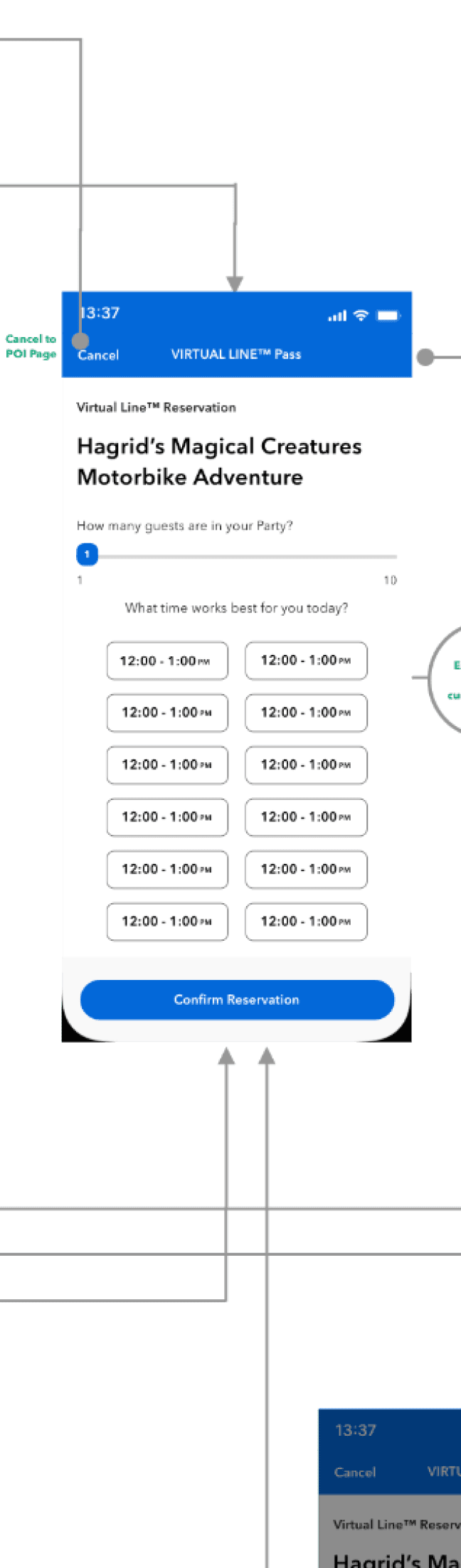
My direction came in the form of a set of criteria and threshold features outlined in a Product Requirements Document (PRD), rather than an open space for exploration or a specific problem to solve.
To the Top
Please remember the following:
"User Stories" represent the outcomes of PRD and user flows based on secondary research and ideation.
"Assumptive Reasoning" denotes the selection criteria for solutions, influenced by secondary research and cross-collaboration meetings.
(Text describes screen seen below)
User Story: When users don't have location or notification settings on, a prompt will appear with two options to proceed. Users need location services for accurate reservation data and notifications to receive updates.
Assumptive Reasoning: To make a VL reservation, users must enable location services for accurate data retrieval. They will also need to enable notifications to receive updates on their reservation.
User Story: Once all permissions are enabled, users in the park can select the number of 'Party Members' for available reservation times. If no times are available, the 'Reservation Window' won't display.
Assumptive Reasoning: To effectively show how the system works in the real world, using an asynchronous display allows us to see what is and isn’t allowed. The design choice aims to prevent errors by ensuring that the 'Party Member' number aligns with the 'Reservation Window' data.
User Story: Once the party size has available reservations, a selection chip grid for 'Reservation Windows' becomes available.
Assumptive Reasoning: To effectively show how the system works in the real world, using an asynchronous display allows us to see what is and isn’t allowed. The design choice aims to prevent errors by ensuring that the 'Party Member' number aligns with the 'Reservation Window' data.
User Story: Ticket scanning at Universal Studios now uses digital platforms for consistency and efficiency. Users can access a VL QR code similar to traditional park entry tickets.
Assumptive Reasoning: The reservation process is divided into two steps to help users understand the Virtual Line Experience. Descriptors below each section's header explain the function and purpose of each step.
The Virtual Line Experience development started in the final quarter of 2023, followed by extensive feature testing and inquiries into user motivations and product solutions.
I contributed to the quality assurance process at Universal, providing insights to our engineers and gaining a better understanding of our capabilities.
I'm grateful for the support from the Universal team, my mother, and God.
Isaiah Morales